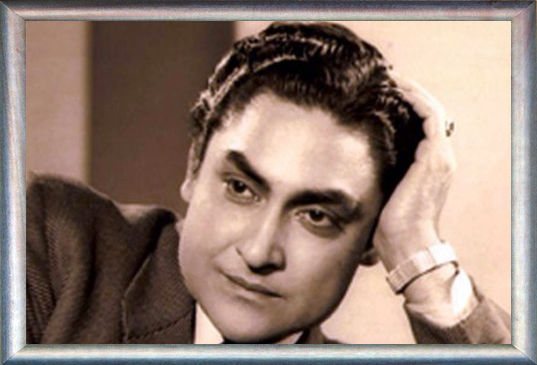
When Ashok Kumar began his career in cinema, German director Franz Osten wrote him off at the very outset. "You will never make it in films because of your tremendous jaw," the famed director of the classical hit "Achut Kanya" had told Kumar. The year was 1936. During the shooting for "Achhut Kanya", in which Kumar played the male lead, Osten hauled up the newcomer numerous times. The nervous Kumar was at his wit's end. Sixty-five years later and with more than 270 films to his credit, Kumar emerged as one of India's celluloid legends. Far from Osten's assessment, the argument now is whether Kumar was not Indian cinema's most enduring lead actor.
Born Kumud Lal Kunjilal Ganguly at Bhagalpur, Bihar, in 1911, Ashok Kumar was the oldest of the three famous Ganguly brothers - Ashok, Anup and
Kishore Kumar. Ashok Kumar spent his early years in Khandwa, Madhya Pradesh.
Be it the handsome, soft-spoken lover or the middle-aged crook or later still the affable grandfather, Kumar not only left an indelible mark on the big screen but also won millions of fans as a singer in his earliest films. The song 'Main Ban Ki Chidiya..' he sang for "Achut Kanya" was a rage in its time. Kumar's entry into acting appears to have been accidental. A science graduate, he became a film buff and wanted to make a career as a director. In 1934, he used his examination fee of Rs.35 for a law degree to buy a ticket for Mumbai. He landed up at the
Bombay Talkies, then the nerve-centre of India's film world. He was hired by
Bombay Talkies owner
Himanshu Rai for Rs 150 as a trainee technician and a camera assistant. Months later, he became a laboratory assistant and his salary rose to Rs 250. In 1936, when Rai was producing "Jeevan Naiya", the original hero of the film Najmul Hussein failed to turn up for shooting. Rai asked Kumar to do the make-up. "Jeevan Naiya" was a runaway hit. Kumar's success was confirmed with his next film "Achut Kanya". The astounding success of the film, considered a classic of all times, turned the pair of Kumar and
Devika Rani, that had also appeared in "Jeevan Naiya", into a hit combination.
Early in his career, he played second fiddle to
Devika Rani, and it was with films like Kangan, Bandhan and Jhoola that he was recognised as a hero in his own right. All the three films had Leela Chitnis playing the female lead. Film critics say Kumar's acting career can be clearly divided into three phases. The days of the handsome, soft-spoken romantic hero in enduring films like "Kismet" and "Kangan", the years as tough-talking hero in films like "Sangram," "Mahal," "Samadhi" and "Howrah Bridge" and finally the character actor in films like "Aashirwad," "Mili," "Khoobsurat" and "Shaukeen."
He starred in a series of crime films like Sangram, Inspector, Howrah Bridge and Night Club, all in the fifties, when he had stiff competition in the form of Dev Anand, Dilip Kumar and Raj Kapoor. He charmed the audience with movies like Deedar and Bewafaa where he shared the screen with the leading trio of moviedom. With the riotous Chalti Ka Naam Gaadi, he displayed his flair for comedy. In the mid sixties, he turned to character roles, including the suave villain of Jewel Thief and the caring father of Mili. By playing the rapist in Jawab (1970), he broke the conventional mould. It was in Khubsoorat, in 1980, that he played one of his memorable roles. With a repertoire of around 300 movies, he quit the scene due to poor health.
He got the most prestigious
Dada Sahab Phalke Award in 1988, for his dedicated contribution to Hindi cinema. Fondly called Dada Moni, he was a doyen in the true sense of the word. With his penchant for blending into every character and merging with the role, Ashok Kumar was addictive to filmmakers and audiences alike. For more than six decades, he never acted - he became whatever character he played.
He acted in fewer films in the 1980s and 1990s, and occasionally appeared on television, most famously anchoring the first Indian soap opera Hum Log and appearing as the title character in the unforgettable Bahadur Shah Zafar.
Ashok Kumar's last film role was in the 1997 movie Aankhon Mein Tum Ho. Besides acting, he was an avid painter and a practitioner of homeopathy. A qualified homoeopath, Ashok Kumar earned a reputation for conjuring up miracle cures. Altogether, he starred in over 300 films. He has done more than 30 Bengali dramas in Dhakuria.
Ashok Kumar died at the age of 90 in Mumbai on 10 December 2001 of heart failure at his residence in Chembur. The then Prime Minister Atal Bihari Vajpayee described him as "an inspiration... for many generations of aspiring actors.